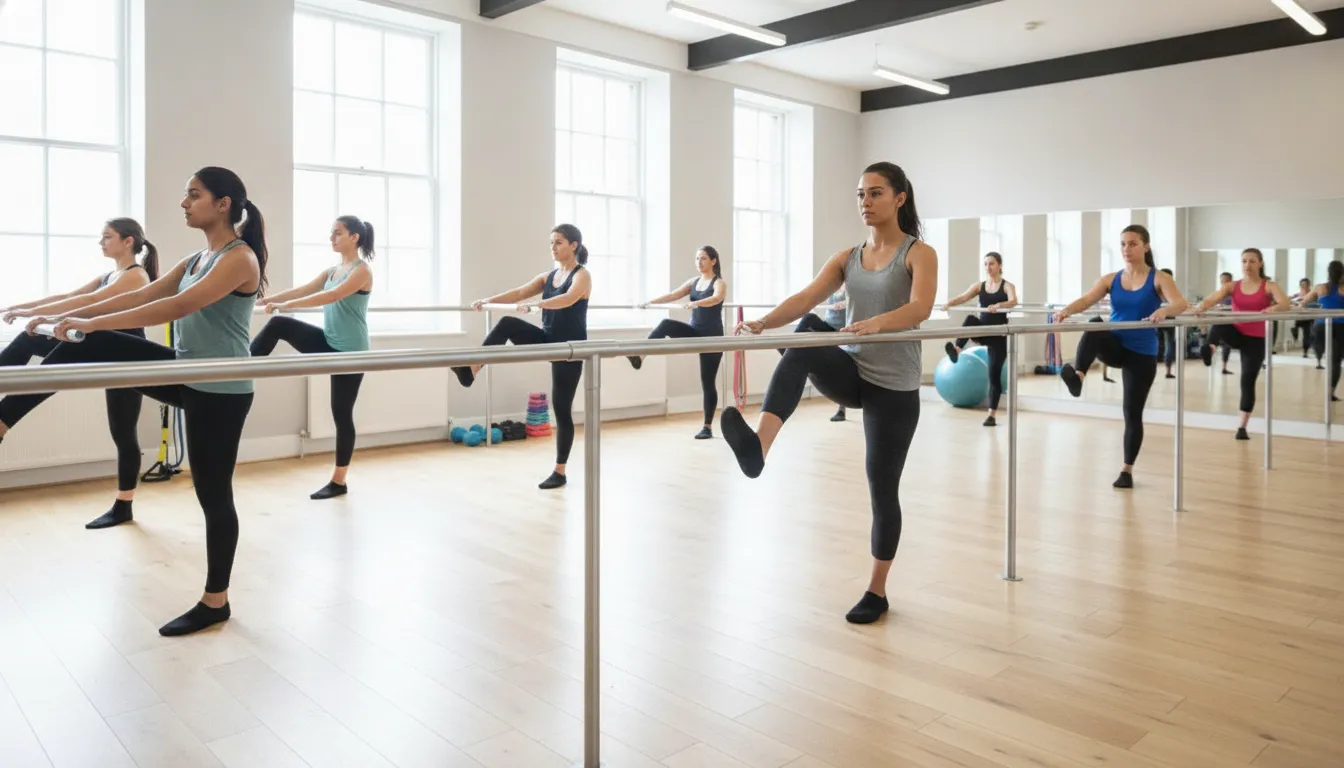
A barre workout can look small from the outside: a steady hold, a controlled lift, a few inches of movement. That is the point. Instead of chasing momentum, barre keeps muscles working under control until they have to adapt.
Try a Pilates and Barre Fusion class at Grind House
What is barre? It is a low-impact, ballet-inspired workout that combines barre positions with Pilates-style core work, yoga-influenced mobility, and high-repetition holds and pulses to build strength, balance, posture, and flexibility.
You do not need dance experience, a ballerina’s flexibility, or a taste for studio theatrics. At Grind House, Pilates & Barre Fusion brings the method into a practical, community-focused training environment in Williamsburg and Flatiron. The work is precise, scalable, and more challenging than the small movements suggest.
To understand why barre creates that kind of fatigue, start with the method itself: where its ballet roots meet functional strength training.
What Is Barre, Exactly?
So, what is barre? It is a low-impact workout built around small, controlled movements that challenge specific muscles without pounding your joints. The method draws from ballet, Pilates, and yoga, but it is not a dance class and you do not need a dance background to participate. Barre uses the structure of ballet training, the controlled core work of Pilates, and the alignment and mobility principles found in yoga.
Most barre exercises happen at a ballet barre, which provides light support as you work through precise positions, holds, pulses, and transitions. The movements may look small from the outside. That does not mean they are easy. Holding a position under tension, then adding tiny pulses or repetitions, can fatigue a muscle quickly. The goal is control rather than momentum. You are not swinging through a movement or relying on speed to get through it.
Small movements, serious muscle work
The technical term for one of barre’s defining methods is isometric exercise. An isometric movement creates tension while the joint stays relatively still. Think of holding a squat at a specific depth, maintaining a plank, or pausing in a raised-leg position. Barre combines those holds with short, controlled ranges of motion and high repetitions. This approach builds muscular endurance while asking you to pay attention to alignment, breathing, and form.
That focus also makes barre different from a workout based entirely on heavy lifting or fast cardio. You may use your body weight, a barre, and later a small prop such as light weights, a ball, or a resistance band. The equipment is secondary. The work comes from positioning the body well and staying engaged through each repetition.
What barre trains
Barre sessions commonly target the core, legs, glutes, and upper body, while also asking you to stabilize through your feet, hips, and shoulders. Because the method emphasizes posture and alignment, it can help you become more aware of how you stand, move, and brace. The Mayo Clinic Press describes barre, Pilates, and yoga as low-impact options that can support posture, core strength, balance, and range of motion without placing a lot of stress on the joints. Read the Mayo Clinic Press comparison of barre, Pilates, and yoga.
Barre is best understood as focused strength and conditioning, not a shortcut or a performance. You show up, learn the positions, and build control over time. The movements are accessible, but the effort is real. That combination makes barre a practical option for anyone who wants low-impact training with a clear emphasis on strength, flexibility, stability, and consistent progress.
Where Did Barre Come From?
Barre did not start as a polished boutique workout with matching outfits and a carefully curated playlist. Its roots go back to Lotte Berk, a London-based dancer who developed a new approach to movement in the 1950s and 1960s. After suffering a back injury, Berk combined the control and alignment of ballet barre work with exercises designed to support rehabilitation and build strength.
That combination was practical. Ballet training demands posture, balance, precision, and serious lower-body endurance, but a barre session is not simply a dance class. Berk adapted familiar ballet positions and supported movements so people could work specific muscles without needing to perform choreography or leap across a studio. The result was a method built around controlled range of motion, focused holds, and repeated movements that challenge the muscles without relying on high-impact pounding.
From there, the method continued to evolve. Early barre training was influenced by ballet, but it also picked up ideas from rehabilitation exercise, Pilates, and yoga. Each influence added something useful. Ballet contributed alignment and leg positions. Rehabilitation emphasized controlled movement and attention to the body. Pilates brought more focus to the core and deliberate muscular control, while yoga reinforced balance, mobility, and body awareness.
Modern barre classes carry those ideas forward, even when the format looks different from Berk’s original work. A class may use a fixed barre, a mat, light weights, a small ball, or resistance bands. The movements are usually small and precise rather than dramatic. You may hold a position, pulse through a short range, or move slowly enough to notice exactly where the work is happening.
That is why barre translated so well to today’s boutique fitness scene. It can be taught in a group setting, adjusted for different experience levels, and combined with other training styles without losing its identity. A Pilates and Barre Fusion class, for example, can pair barre’s standing leg and seat work with Pilates-based core control and mat exercises.
The through line is still the same: use precise movement to build strength and control. You do not need a dance background, and you are not expected to look like a professional ballerina. What matters is showing up, learning the positions, and staying honest about the work. Barre’s history may begin with a dancer solving a problem after an injury, but its staying power comes from a method people can make their own.
What to Expect in a Barre Class
A typical barre class takes about 45 to 60 minutes and moves through controlled exercises that challenge your muscles without pounding your joints. The work can look subtle from the outside, but small pulses, isometric holds, and high-repetition sets create serious muscular fatigue. That is the point: barre is low-impact on your joints while still delivering high-intensity strength and conditioning.
You will use the ballet barre as a support for balance, not as something to pull against or hang on. Light hand weights, small balls, and resistance bands may also appear throughout class. These props add leverage or resistance while keeping the focus on alignment, control, and sustained effort. The basic equipment and movement format are consistent with descriptions of barre training that emphasize the barre, weights, bands, and balls as exercise tools (source details on barre equipment).
Here is how the flow usually unfolds:
- Warm up and set your alignment. Class begins with movements that raise your temperature and prepare your core, legs, and shoulders. You may work through standing positions, gentle mobility, and posture cues. The goal is to establish a stable foundation before the smaller, more demanding sets begin. Keep your ribs stacked over your hips, soften your knees when instructed, and focus on the quality of each repetition.
- Move into barre work. You will stand at the barre for lower-body exercises such as plies, leg lifts, and targeted pulses. The barre gives you an added point of contact, making it easier to practice positions that require balance or stability. It is a practical support, especially when you are new to the format. Expect instructors to ask for tiny movements or a static hold instead of a large range of motion. Holding a position under tension trains muscular endurance, even when the movement looks small.
- Add props and upper-body work. Light weights, resistance bands, or a small ball may make familiar exercises more demanding. You might hold weights through controlled arm sequences while your legs remain under tension, or place a ball between your thighs to create an additional alignment cue. Props are not there to distract from technique. They help you build control and stay engaged through the full set.
- Take the work to the floor. Floor exercises often target the core, glutes, and hips through bridges, leg extensions, abdominal work, and more pulses or holds. Because you are supported by the mat, you can concentrate on the muscles doing the work rather than on impact or momentum.
- Finish with a focused stretch. The final minutes bring your heart rate down and address the muscles you used most. Expect stretches for the hips, legs, shoulders, and back, with reminders to breathe and avoid forcing range of motion.
If you want a fuller studio-focused overview, read what to expect from a barre class. The format is approachable, but do not mistake approachable for easy. Consistent control, precise alignment, and patient effort make each minute count.
What Is Barre vs. Pilates?
Barre and Pilates share a focus on control, alignment, core strength, and low-impact movement, but they create that challenge in different ways. Barre borrows its vocabulary from ballet. You may work in turned-out positions, use a barre for support, and hold a muscle under tension while adding small pulses. Pilates is more concerned with precise core control, breath, and coordinated movement on a mat or reformer.
That difference changes how each class feels. Barre often builds intensity through higher repetitions and isometric holds. A movement may look tiny, but the sustained tension can make a specific muscle group work hard. Pilates typically asks you to stabilize your trunk while moving your limbs with deliberate precision. Neither format requires a high-impact approach, and both can support posture, balance, flexibility, and range of motion without placing heavy stress on the joints. Mayo Clinic notes that Pilates, yoga, and barre can improve posture, core strength, balance, and range of motion through joint-friendly movement.
| Category | Barre | Pilates |
|---|---|---|
| Influence | Draws from ballet, with additional Pilates and yoga elements. | Developed around controlled exercise, core stability, breath, and alignment. |
| Primary focus | Muscular endurance, posture, alignment, and full-body strength through targeted fatigue. | Deep core control, spinal stability, coordinated strength, and efficient movement. |
| Equipment | A ballet barre may be paired with light weights, bands, or small balls. | A mat is common; reformer and other apparatus may add resistance and support. |
| Movement style | Small-range holds, pulses, repeated lifts, and ballet-inspired positions. | Controlled sequences that coordinate breath, trunk stability, and deliberate limb movement. |
| Best for | People who enjoy rhythmic repetition, focused muscle work, and a ballet-influenced workout. | People who want measured core training, improved body awareness, and precise movement practice. |
The formats are not opposites. They overlap in their emphasis on controlled, low-impact training, and a barre class may incorporate Pilates-based exercises. The practical distinction is the class’s center of gravity: barre tends to use the barre, positions, holds, and pulses to challenge muscular endurance, while Pilates prioritizes core organization and breath throughout each sequence.
If you want both approaches in one workout, explore Pilates and barre fusion at Grind House. It is a useful option for anyone who wants the focused strength of barre and the controlled core work of Pilates without treating either method as a competition.
What Are the Benefits of Barre?
Barre earns its place in a serious training routine because it makes controlled movement difficult without beating up your joints. You work through small ranges, hold positions under tension, and stay focused on alignment instead of chasing speed or impact. The result is a demanding session that trains control, endurance, and stability.
One of the clearest advantages is low-impact conditioning. Barre can challenge your muscles while placing less stress on the joints than high-impact jumping or running. The Mayo Clinic Press notes that barre can support posture, core strength, balance, and range of motion without putting a lot of stress on the joints. That combination makes it useful for people who want a challenging workout but need to manage impact.
Build strength that lasts
Barre’s signature holds and pulses are not decoration. They are isometric work: the muscle stays under tension while the joint remains relatively still. Holding a position when your legs are shaking trains muscular endurance, or your ability to keep producing force over time. You may not move a heavy barbell, but you are learning to maintain position and control when fatigue sets in.
That endurance carries into practical movement. Stronger hips, legs, and core muscles can help you stay steady during lifts, climbs, walks, and other daily activities. Barre also combines small, controlled movements with elements of ballet, Pilates, and yoga, creating a training effect that is more complete than a single-muscle burn.
Improve posture, balance, and range of motion
Good posture is not just standing tall for a photo. It is the ability to organize your ribs, pelvis, spine, and shoulders while you move. Barre places consistent attention on alignment, which gives you more awareness of how your body is positioned. That awareness can help you stop compensating with one area while another area does not contribute enough.
Balance improves for the same reason. You practice stabilizing through the feet, hips, and core while moving slowly and deliberately. The barre provides support when needed, allowing beginners to work on control before they have mastered every balance demand. Over time, that support can become a tool for better technique rather than a crutch.
The repeated emphasis on length, alignment, and controlled range also supports flexibility and mobility. You are not forcing a stretch or throwing your body into a position. You are building strength while moving through a usable range, which is a more useful goal for functional training.
A practical entry point for a new routine
Barre is accessible because you do not need dance experience to start. The movements can be scaled, the barre offers stability, and the work is precise enough for a coach to adjust your position. For someone rebuilding consistency, that matters. The Mayo Clinic Press describes barre as a possible first step for people building a new exercise routine.
At Grind House, Pilates & Barre Fusion frames those benefits as real training: core stability, flexibility, balance, and controlled strength in one focused class. It is low impact, but it is not low effort. Show up, learn the positions, stay honest through the holds, and let the work build.
Is Barre Good for Beginners and Weight Loss?
Yes, barre can be a smart starting point, even if you have never taken a dance class or followed a structured workout plan. The movements are controlled, and most exercises can be adjusted by changing your range of motion, reducing the hold time, or taking a lighter option. You do not need ballet technique to participate. You need enough focus to follow the instructor, listen to your body, and keep showing up.
The barre also gives beginners something useful: support. Holding it can make a standing position feel more stable while you learn how to engage your core, align your hips, and control your legs. That extra balance point lets you work on form instead of fighting to stay upright. Research and educational fitness guidance describe barre as an accessible entry point for people building a new exercise routine, with low-impact movements that place less stress on the joints. Mayo Clinic Press explains how barre can support posture, core strength, balance, and range of motion.
How difficult is barre for beginners?
Barre is beginner-friendly, but that does not mean it is effortless. Small pulses and isometric holds can challenge a muscle quickly because you are keeping it under tension rather than relying on momentum. You may feel your legs shake or your core work hard before your breathing becomes heavy. That is normal. It is also why a good class offers modifications instead of treating one position as the only correct version.
Start with the version you can control. Keep the range of motion small, release a hold when your form breaks down, and use the barre for balance rather than pulling your body into position. As your coordination and muscular endurance improve, you can gradually add time, range, or resistance. No dance experience is required, and the workout can meet you at your current fitness level.
Can barre help you lose weight?
Barre can contribute to a weight-loss routine, but it should not be marketed as a magic solution or a guaranteed high-calorie burn. Its main strengths are muscular endurance, lean strength, posture, balance, and low-impact conditioning. Those benefits can help you build a consistent exercise habit, especially if high-impact workouts do not suit your joints or schedule. Barre’s controlled work can make your muscles feel challenged without serving as a substitute for every type of training.
For weight loss, combine barre with a broader plan that includes strength and cardio, along with eating habits that support your goal. Grind House offers eight class modalities, so you can pair Pilates & Barre Fusion with more strength-focused or cardio-focused sessions. That gives your week more variety and supports a balanced training routine instead of asking one class to do everything.
The honest answer to “what is barre” for a beginner is simple: it is a scalable, low-impact strength and conditioning workout. It can help you build the consistency and control that make a larger fitness plan sustainable. If weight loss is your goal, use barre as one useful part of that plan, not the entire plan.
Try Barre at Grind House in Williamsburg and Flatiron
Once you understand what barre is, the next step is finding a room where the workout feels practical, focused, and worth your time. Grind House brings Pilates & Barre Fusion into a full training environment, with the energy of a community gym and the structure of a coached class.
The Williamsburg location is at 203 Berry Street, making it a convenient option for Brooklyn members who want to build strength without crossing the city. The Pilates & Barre Fusion class is one of eight included class modalities. So barre can be part of a broader routine rather than your only form of training. Add strength work, conditioning, or another class when your goals call for it.
What makes Pilates and barre fusion different?
Fusion classes combine the controlled core work and movement awareness associated with Pilates with barre’s small-range pulses, holds, and balance-focused training. That combination suits people who want more than a casual stretch but prefer a lower-impact approach to conditioning. You do not need a dance background. You need enough focus to follow coaching, control your movement, and stay engaged when a small exercise starts to test your muscles.
It can work well for busy professionals, beginners building consistency, and experienced gym-goers who want to improve core stability, posture, flexibility, and muscular endurance. The class is challenging without relying on unnecessary theatrics. You show up, learn the movement, work through the set, and keep improving.
A community-driven approach in two NYC locations
Grind House also serves members near Flatiron, giving Manhattan-based professionals access to the same direct, results-focused training mindset. If you are comparing group barre fitness classes, look for a schedule and coaching environment that make regular attendance realistic, not just a class that sounds good on paper.
For a closer look at the blended format, explore Pilates and barre fusion. At Grind House, the message is simple: Rise, Grind, Repeat. The goal is real training, real results, supported by a community that expects you to keep showing up.
Reach out to book a barre class near you
Frequently Asked Questions
Is barre a good workout for beginners?
Yes. Barre is an accessible way to start a new exercise routine, and you do not need dance experience to participate. The barre provides support while you learn the positions, alignment, and controlled movements. Instructors can also modify range of motion, resistance, or balance demands so you can build confidence without forcing a movement your body is not ready for.
Is barre the same as Pilates?
No. Both methods emphasize control, core engagement, alignment, and low-impact movement, but they use different foundations. Barre blends ballet-inspired positions and holds with elements of Pilates and yoga. Pilates places more emphasis on mat or apparatus-based control, breath, and precise movement patterns. A Pilates and Barre Fusion class can bring both approaches together while keeping the workout focused and practical.
What equipment do you need for barre?
Most classes use a ballet barre for support, along with optional props such as light weights, resistance bands, and small balls. The equipment is not there to make the workout complicated. It helps you challenge stability, create resistance, or maintain better positioning while performing small, controlled movements.
Can barre help with strength and flexibility?
Barre develops muscular endurance through isometric holds, pulses, and repeated movements performed under tension. It can also support posture, core strength, balance, and range of motion without placing heavy stress on the joints, according to Mayo Clinic. For broader conditioning or weight-loss goals, pair barre with other strength and cardio training instead of treating it as your only workout.
Ready to Try Pilates and Barre Fusion?
Barre gives you a focused way to build control, stability, and strength while keeping the work approachable. It is low impact on the joints, scalable for any fitness level, and demanding enough to keep building on you week after week. Whether you are new to a structured routine or an experienced gym-goer looking to refine posture. Balance, and muscular endurance, a barre session fits into a practical training week.
At Grind House, Pilates and Barre Fusion is a coached, community-driven class at our Williamsburg and Flatiron locations. You do not need dance experience to start, and you will leave with a clear sense of what your body can do under control. Schedule your Pilates and Barre Fusion class and get started today.
Leave a Reply
You must be logged in to post a comment.