New York City gives you no shortage of ways to move, but the right Pilates class should do more than fit neatly into your calendar. It should match your goals, experience level, preferred training style, and the kind of community that keeps you coming back.
For many New Yorkers, new york pilates is a practical way to build control, core strength, and body awareness without high-impact stress. Pilates can be especially useful for people managing pain or returning from an injury because it is gentle and low-impact, according to Hospital for Special Surgery.
Across Manhattan and Brooklyn, you’ll find mat classes, reformer sessions, and hybrid formats that bring different demands and benefits. Grind House’s Pilates & Barre Fusion adds a training-focused option in Williamsburg, combining controlled Pilates work with the challenge of barre. Start by narrowing down what you need from a class, then compare the details that shape the experience.
How to Find the Best New York Pilates Class for You
The right class starts with your reason for showing up. Pilates can be a smart choice for low-impact strength, better posture, or a measured return to exercise after an injury. Hospital for Special Surgery describes Pilates as gentle and low impact, which can make it suitable for people recovering from injury or managing pain. That does not mean every class is appropriate for every condition, so be clear about your current needs and speak with a qualified health professional when necessary.
Use your goal to narrow the field before comparing schedules. A class designed around controlled strength may suit someone who wants a stronger core and more support for daily movement. Someone focused on posture may want coaching that emphasizes alignment, breathing, and precise technique. If you are rebuilding confidence after an injury, prioritize instructors who ask about limitations and offer practical modifications rather than expecting everyone to follow the same progression.
Start with a class that meets you where you are
Beginner-friendly does not have to mean easy or watered down. It should mean the instructor explains the setup, demonstrates key movements, and gives you a clear way to reduce or increase the challenge. Pilates can be performed on a mat or with equipment such as a reformer. And the exercises and equipment can be adjusted to suit different bodies and fitness levels. That flexibility lets a new participant learn the fundamentals without treating a lack of experience as a problem. Look for class descriptions that explain the level honestly, and ask what someone should expect during a first visit.
It is also worth checking how much guidance you will receive. A smaller class may make it easier to ask questions and receive form cues. If you need more individualized attention, ask whether the studio offers private sessions or recommends a suitable small-group option. A good first class should leave you challenged, informed, and able to identify what to work on next, not overwhelmed by unfamiliar equipment.
Make the practical details part of your shortlist
- Schedule: Choose a studio with class times you can realistically attend each week, including options near work or home.
- Format: Check whether the class uses a mat, equipment, or a blend, and whether modifications are available.
- Cost: Compare introductory offers, single-class pricing, and memberships against the frequency you expect to attend.
- Access: Consider the commute, booking process, cancellation policy, and what you need to bring.
As you compare boutique fitness studios in NYC, prioritize consistency over novelty. The best option is usually the class you can attend regularly, with coaching that respects your starting point and a format that supports your goal.
What to Look for in a New York Pilates Studio
The right studio should make it easier to train consistently, not leave you guessing whether the class matches your body or your goals. Start by looking at the instructor’s qualifications and teaching style. A certified instructor should be able to explain alignment, offer useful modifications, and watch how you move instead of delivering the same cues to everyone in the room. Form matters in Pilates because the work depends on controlled, deliberate movement rather than simply completing a high number of repetitions.
Ask how the studio handles different experience levels and physical needs. Pilates can be taught in private, one-on-one sessions or small group classes, which gives members different levels of coaching and support. Hospital for Special Surgery explains that this flexibility can be especially useful for people easing back into exercise after an injury. If you are new to Pilates, returning after time away, or managing a specific limitation. Find out whether the instructor can adjust range of motion, resistance, and exercise selection without making you feel singled out.
Check the format, equipment, and practical details
Class format should match what you want from each session. Private training may make sense when you need highly individualized instruction or are rebuilding confidence. A small group can offer coaching while still bringing energy and accountability. Either way, ask how many people attend, how much individual feedback is typical, and whether the class is mat-based, equipment-based, or a blend. Equipment should be clean, stable, and well maintained. If the studio uses Reformers, ask whether instructors teach members how to adjust springs and set up safely.
Location is part of the decision, too. A studio that takes 45 minutes each way may be difficult to sustain, even if the first class feels perfect. Check the route from work or home, available class times, cancellation policies, and whether the schedule gives you realistic options during a busy week. Consistency usually matters more than choosing the most elaborate facility across town. Exploring NYC fitness classes can also help you compare studios based on commute and schedule fit.
Match the studio to your goal
Finally, be specific about what you want to improve. If your priority is joint-friendly strength, look for instructors who emphasize muscle control and precise alignment. Those principles can support more efficient joint movement and may be particularly helpful for people with arthritis. If you are coming out of rehab, ask how classes address mobility and range of motion, both of which are important parts of recovery. A good studio will welcome those questions and explain what it can and cannot provide.
- Check for instructor certification, hands-on coaching, and clear form corrections.
- Confirm the studio offers private or small group formats that suit your experience and support needs.
- Look for clean, dependable equipment and an appropriate class size.
- Pick a commute and schedule you can maintain week after week.
- Choose programming that aligns with your goals, from mobility to controlled strength.
Reformer vs Mat Pilates: Which NYC Class Fits You?
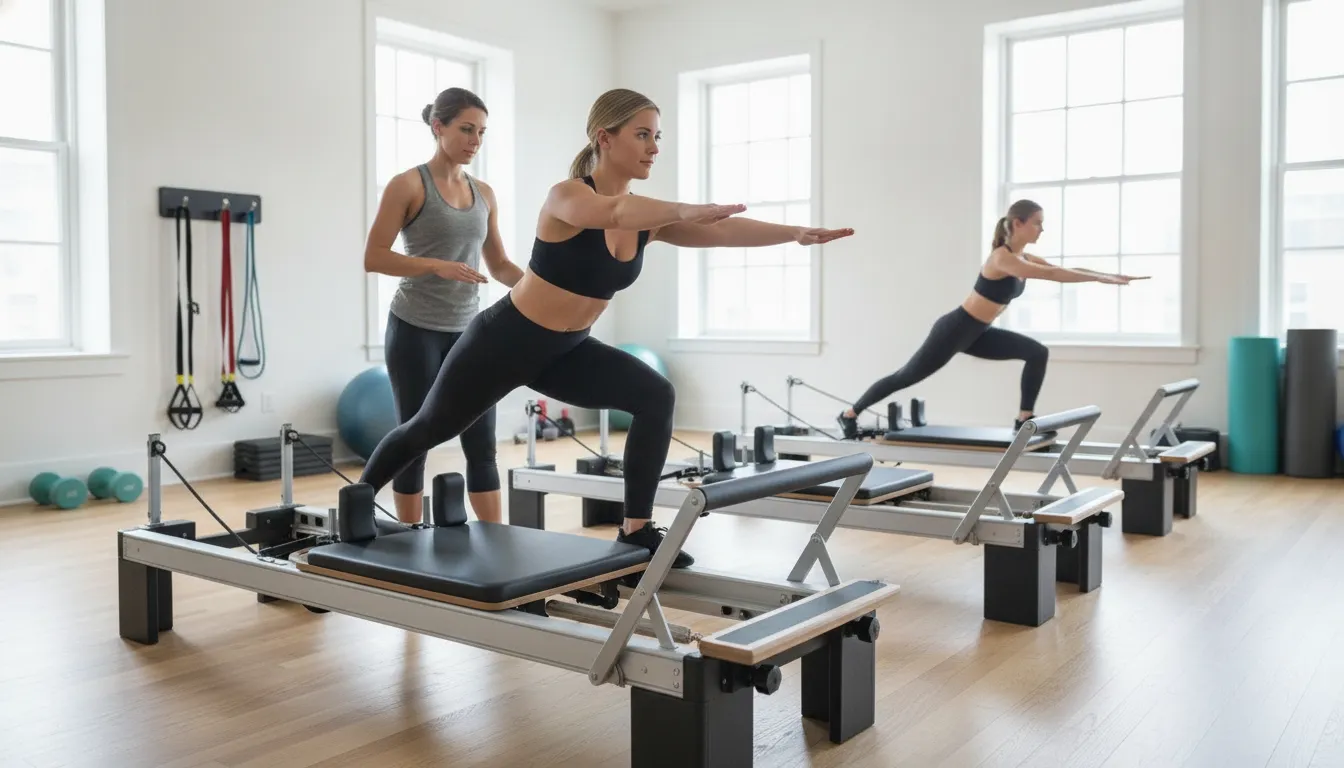
Mat and Reformer Pilates share the same focus on controlled movement, breathing, alignment, and core engagement. The main difference is how you create support and resistance during each exercise. Mat Pilates uses your body weight on a mat. Reformer Pilates adds a moving carriage, straps, and springs that can challenge or assist your movement.
The Reformer uses springs for both resistance and assistance, which can help you find balanced muscle engagement. The equipment also gives your instructor more ways to adjust the exercise. Mat work can look simple, but it can still demand serious control when you slow down and maintain precise form.
| Factor | Reformer Pilates | Mat Pilates |
|---|---|---|
| Equipment and experience | Moving carriage, straps, footbar, and springs. | Mat-based practice using body position and control. |
| Resistance | Adjustable springs provide resistance or assistance. | Body weight, gravity, and exercise leverage. |
| Intensity | Can feel more supported or more demanding. | Builds challenge through tempo, range, and control. |
| Suited to | People who want equipment feedback or varied loading. | People who value simplicity, portability, and fundamentals. |
| Cost and access | Requires studio equipment and often smaller class capacity. | Needs only a mat, making it easier to practice anywhere. |
Choose based on your training goal
Choose Reformer Pilates if you want adjustable resistance, equipment feedback, or a class that changes the challenge without relying only on added weight. The carriage can make some positions more accessible while springs make other movements demanding. It is a useful option when you enjoy coaching cues and a structured studio setting.
Choose Mat Pilates if you want to master foundational movement, improve body awareness, or practice outside the studio. It is also practical for a busy New York schedule because the method requires minimal equipment. A strong mat class can train your trunk, hips, shoulders, and posture without a machine.
Neither format is automatically better. Both can be modified for any body or fitness level, so your instructor can adjust the exercises to match your experience and current needs. If you are managing pain, arthritis, or returning from rehabilitation, ask your medical professional and instructor how to scale the session.
Still deciding? A blended approach can give you the best of both formats. Try Pilates and Barre fusion if you want Pilates-based control with a faster, more varied class experience. Start with the format that matches your goal, then explore the other as your confidence grows.
Where to Find Pilates Options Across New York
New York gives you plenty of ways to build Pilates into your routine, whether you want a dedicated reformer studio. A class inside a larger boutique fitness hub, or a neighborhood gym where Pilates is part of a wider training schedule. In Manhattan, start by looking around the areas you already travel through. Dedicated studios are common in Midtown, Flatiron, the Upper East Side, and downtown, making it easier to choose a class near work, home, or a regular commute. Some focus almost entirely on reformer work, while others combine mat Pilates with strength, mobility, or barre.
Brooklyn offers a different feel. Williamsburg has a strong concentration of independent fitness businesses, with local boutiques serving residents who want consistent coaching without crossing the river for every workout. You will also find options in Greenpoint, Downtown Brooklyn, Park Slope, and other neighborhoods where the best studio may be the one that fits your actual week. A convenient location matters. The class you can attend regularly will usually do more for your progress than a highly rated studio that takes an hour each way.
Aggregators can help you compare that larger landscape. ClassPass-style platforms let you search by neighborhood, time, class format, and availability. Their popularity lists can reveal which studios are drawing consistent interest, but treat those rankings as a starting point rather than a final verdict. Check the class description, instructor experience, cancellation policy, equipment, and level guidance before booking. An editorial roundup can be useful for discovery too. Vogue has highlighted five New York studios in one Pilates guide. While ClassPass reporting cited by Vogue identified Pilates as one of the fastest-growing exercise trends in the United States. Those lists show where attention is going, but they do not replace a trial class or a look at the studio’s day-to-day fit.
The training itself is worth considering alongside the neighborhood. A review published in PubMed found that Pilates improved abdominal muscular endurance in healthy individuals, and some randomized trials reported improvements in dynamic balance and quality of life: read the research summary. Those benefits make it reasonable to compare coaching quality and class consistency, not just a studio’s photography or online popularity.
For Williamsburg residents, Grind House is a local option at 203 Berry Street, near the Bedford Avenue L train stop. The gym offers eight class types, including Pilates & Barre Fusion, alongside broader training options. If you are comparing boutique fitness studios in NYC, a neighborhood-based schedule can give you the variety of a full fitness hub while keeping your Pilates routine close to home.
How Grind House’s Pilates & Barre Fusion Fits Into the NYC Pilates Scene
New York Pilates can mean a lot of different things, from focused reformer work to mat-based conditioning and movement classes that fit into a packed workweek. Grind House brings that same range to Williamsburg, with Pilates & Barre Fusion as one of eight class types included under one membership. The goal is straightforward: give Urban Grinders real training, real results, and a real community without making fitness feel like a performance.
One class, two useful training perspectives
Pilates contributes the control. You work through deliberate positions, steady breathing, and core engagement instead of rushing through a movement just to get more repetitions. On a reformer, springs provide resistance and assistance, which can help create balanced muscle engagement across a movement. The Hospital for Special Surgery explains how the reformer’s spring system can support that balance while allowing the equipment to be adjusted to the person using it: HSS explains the benefits of Pilates.
Barre adds a different challenge. Ballet-inspired sequences use small, controlled pulses, holds, and repeated lower-body movements that test muscular endurance. In a fusion class, those elements work alongside Pilates-based core control rather than competing with it. The result is a functional, full-body session that asks you to stabilize, move with intention, and stay engaged from the center through the legs and upper body.
Built for Williamsburg schedules and real life
Grind House is at 203 Berry Street in Williamsburg, Brooklyn, a short walk from the L train’s Bedford stop. The gym is open 107 hours each week, so a class can fit before work, after the office, or into a weekend routine without requiring a major commute. That matters in NYC, where the best class is often the one you can attend consistently.
The setting is boutique-quality, but the approach stays practical. One membership gives members access to eight class types, making it easier to combine Pilates &. Barre Fusion with other forms of training instead of treating one class as a complete fitness plan. Unlimited membership is $124.99 per month, a mid-market price for people who want coached classes and variety without paying for unnecessary posturing.
For a closer look at the format, visit Pilates and Barre fusion. If you want to ask about class fit, scheduling, or membership options, use the Grind House contact page and connect with the team.
Frequently Asked Questions
Is Pilates good for beginners?
Yes. Beginners can start with mat work or equipment-based classes, as exercises and resistance can be adjusted to different bodies and fitness levels. Choose a class that explains the setup, emphasizes controlled movement, and gives you room to learn the basics before increasing intensity. If you are returning after an injury or managing pain, ask the instructor about suitable modifications first. Pilates is low impact, but the right class still depends on your current condition. Hospital for Special Surgery explains how Pilates can support a gradual return to movement.
How often should I do Pilates to see results?
Consistency matters more than an occasional hard session. Start with a schedule you can maintain, such as one or two classes each week, then adjust based on your recovery, goals, and other training. Regular practice gives you more opportunities to refine breathing, alignment, and core control. Pairing Pilates with strength, conditioning, or other movement can also help you build a balanced routine rather than relying on one class format for everything.
What is the difference between Pilates and Barre?
Pilates centers on core control, alignment, breathing, and deliberate movement. Barre uses small, controlled movements influenced by ballet training and often places more emphasis on muscular endurance and sustained work. They overlap in posture, stability, and precision, but the pacing and exercise choices feel different. A Pilates and Barre Fusion class combines elements of both, giving you focused core work alongside the burn and rhythm of barre-inspired training.
Do I need special gear for Pilates?
You usually need comfortable workout clothes, water, and grip socks if the studio requires them. Most classes provide the main equipment, including mats and any reformer or barre setup. Check the class description before arriving because footwear, equipment, and arrival instructions vary by studio. Avoid loose clothing that makes it difficult for an instructor to see your alignment, especially when learning new movements.
Ready to Start Your Pilates Journey at Grind House?
Looking for a class that blends controlled Pilates work with the energy of Barre? Grind House’s Pilates & Barre Fusion gives you a focused way to train with the Williamsburg community. Book a Pilates & Barre Fusion class or start with a free trial to find the right next step for your NYC routine.
Leave a Reply
You must be logged in to post a comment.