
A stronger core is not just about doing more crunches. It is about controlling how your body moves, supporting your joints, and building awareness you can use everywhere from the gym floor to a long workday. That is the appeal of reformer pilates: it combines deliberate, low-impact movement with adjustable resistance from springs and pulleys.
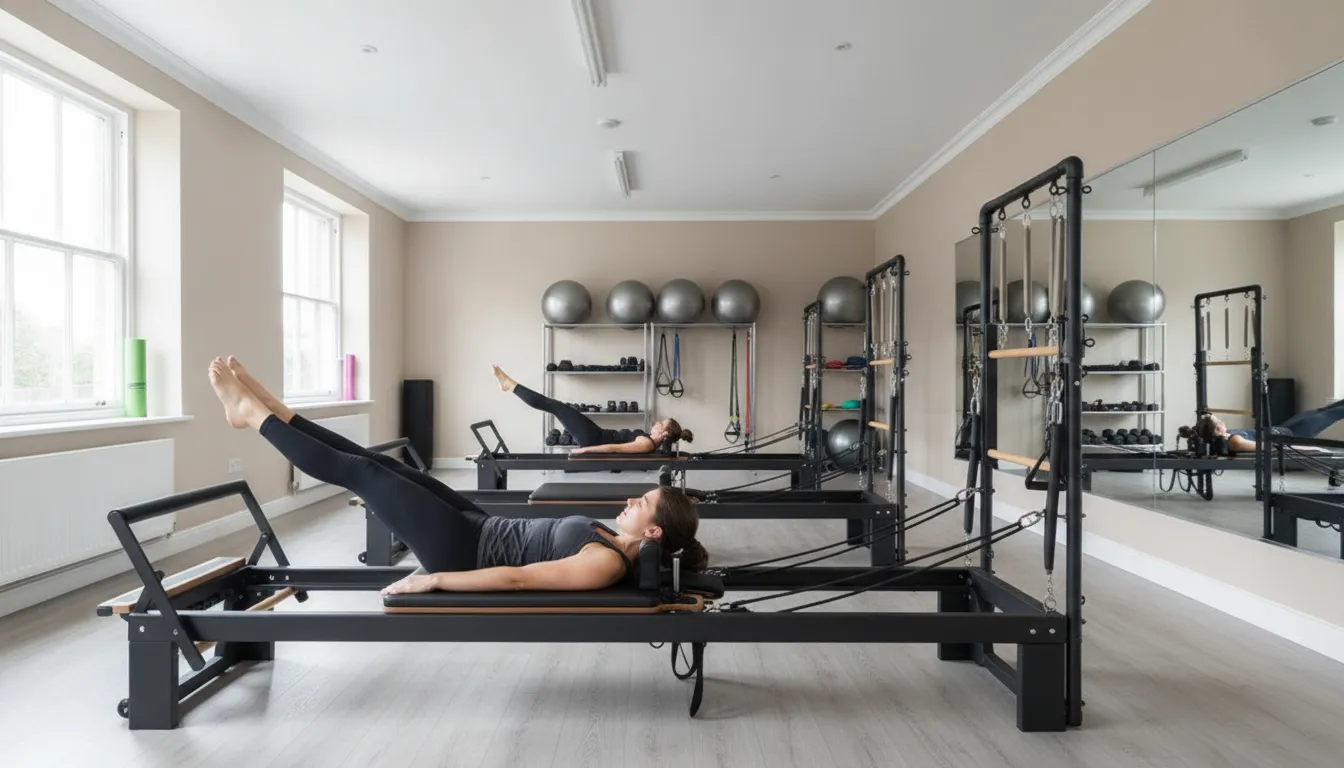
Reformer pilates is a full-body training method performed on a machine with a rolling carriage, springs, straps, and a footbar. The equipment can support or challenge each movement, helping you train core stability, muscular control, balance, and posture in ways that differ from mat Pilates.
The setup may look specialized, but the goal is straightforward: move with precision instead of relying on momentum. Understanding what the machine does, how it changes the workout. And where it fits alongside mat-based training makes it easier to decide whether this style belongs in your routine.
Claim your 3-Day Trial at Grind House to try low-impact, core-focused training for yourself.
What Is Reformer Pilates and Why Is It Everywhere?
Reformer pilates is a full-body training method performed on a specialized machine that uses springs and pulleys to add resistance. Instead of working only against gravity and body weight on a mat, you move a carriage through controlled patterns while the equipment creates tension. The result is a deliberate workout that asks you to manage position, range of motion, and effort at the same time.
The method is not about rushing through a high number of repetitions. Reformer Pilates emphasizes controlled, fluid movement, with exercises designed to build strength and stability throughout the body. That full-body focus is one reason it can feel more substantial than a stretching session while remaining low-impact. The equipment gives the instructor more ways to adjust how challenging a movement feels. Rather than forcing every person in a class to use the same level of resistance.
That adjustability is a major part of the reformer’s appeal. Spring tension can be set to assist a movement or challenge it, depending on the exercise and the person performing it. A beginner may need more support while learning how to control the carriage. Someone with more experience may use a different spring setting to create a stronger demand on the muscles. The same basic machine can therefore meet people at different fitness levels and give them room to progress.
Reformer pilates also earned a strong reputation for improving posture and core control. Staying stable on a moving carriage requires attention to alignment and consistent engagement through the trunk. Over time, that emphasis can make you more aware of how you hold and move your body. Whether you are training, sitting at a desk, or walking through the city. Research has reported positive effects on postural alignment, body awareness, and physical function, although results depend on the individual and the quality of instruction.
Its popularity makes more sense when you look at the combination: resistance without pounding, precise coaching, and exercises that train more than one area at once. It can be challenging without being chaotic, and focused without feeling like isolated machine work. Reformer Pilates is also distinct from every Pilates class that uses the name. A mat-based class can deliver a serious workout, but it does not use the springs, pulleys, and moving carriage that define the reformer.
For a Brooklyn gym member, the practical takeaway is simple: understand whether you want equipment-based reformer training or a mat and barre-style class. Grind House offers Pilates & Barre Fusion as part of its group programming, with an emphasis on core work and flexibility. That is a related offering, but it should not be confused with a dedicated reformer session.
Sources: Mayo Clinic Press overview of Pilates, yoga, and barre; research on Pilates equipment and full-body movement; research on reformer Pilates, posture, and body awareness.
How Does the Pilates Reformer Machine Work?
A reformer is less complicated than it looks. The machine gives your body a moving surface, adjustable resistance. And several ways to position yourself so you can train strength, control, balance, and range of motion in the same session.
The main component is the carriage, a flat platform on wheels that glides back and forth inside a frame. Springs connect the carriage to the frame and create resistance. Depending on the setup, that tension can make a movement more demanding or provide support as you learn the pattern. Research describes this adjustable spring tension as one reason the reformer can be adapted for different fitness levels and abilities. The reformer is designed to assist or challenge movement through its resistance settings.
The springbar holds the springs in place, while the adjustable footbar gives your feet or hands a stable point to press against. Straps or ropes run through pulleys at the end of the frame and attach to the carriage. Those straps let you work your arms and legs while lying down, sitting, kneeling, or standing. You may move from a supine position to prone, side-lying, seated, or standing work without leaving the machine.
- Set the resistance and position. An instructor selects the spring tension and adjusts the footbar for the exercise. You may lie on your back with your feet on the footbar. Face the bar in a plank position, or use the straps while seated or lying on your side. The setup changes the angle, leverage, and amount of support you receive.
- Press into the footbar or straps. In a basic footwork pattern, you place your feet on the footbar and press through your legs. For an upper-body or hip exercise, you may hold the straps and move your arms or legs against the pulley system. The goal is not to shove the carriage as fast as possible. It is to keep your ribs, pelvis, and spine organized while you move.
- Glide the carriage. Your pressure sends the carriage rolling along the frame. The wheels create motion, but your muscles control the direction and distance. A longer glide can challenge strength and coordination, while a smaller range may help you practice alignment or work around a limitation.
- Control the return with the springs. When you release pressure, the springs draw the carriage back toward the frame. You resist that pull instead of letting the carriage slam closed. This controlled return is where the reformer demands precision, balance, and steady breathing. Your deep abdominal muscles help stabilize the body while the limbs move. The machine’s instability requires ongoing core engagement to maintain control.
That push, glide, and controlled return can be made easier with more supportive spring tension or harder with a setting that requires greater effort. More springs do not always mean a harder exercise, because the effect depends on the movement and your position. A qualified instructor chooses the setup that makes the exercise challenging without sacrificing clean form. That versatility is what lets a beginner learn the mechanics while a more experienced client works on strength, stability, or muscular endurance.
Reformer work is also not limited to slow leg presses. The carriage, footbar, straps, and pulleys create a platform for full-body, controlled movement. The machine can support precise mobility work, focused strength exercises, and flowing sequences that ask several muscle groups to coordinate at once.
Reformer Pilates Benefits for Core Strength and Stability
Core training is not only about doing more crunches. It is about keeping your ribs, pelvis, spine, and hips organized while your arms and legs move. Reformer work makes that demand constant. As the carriage rolls and the springs respond, your body has to stay balanced and controlled instead of relying on momentum.
That moving surface creates a useful challenge for the deep abdominal muscles. The transversus abdominis, pelvic floor, diaphragm, and muscles around the spine help stabilize you through each repetition. You may not feel a dramatic burn in the first few seconds, but you will notice when your breathing, alignment, or control starts to slip. That feedback makes it easier to refine technique and build muscular endurance over time.
Why the reformer challenges your core
The machine does not make every movement harder in the same way. Spring tension can assist a movement, provide resistance, or create enough instability that your stabilizing muscles must work continuously. Research describing the reformer specifically notes that deep core engagement helps practitioners maintain balance and control on the moving carriage. See the evidence in this review of Pilates and reformer exercise.
In practice, that can mean slowing down a leg press. Keeping your pelvis level during a side-lying exercise, or holding your trunk steady while the carriage moves beneath you. The goal is not to rush through a large number of repetitions. It is to perform each repetition with consistent breathing, controlled range of motion, and enough tension to keep the movement honest.
Strength without unnecessary joint stress
Reformer Pilates can also support full-body strength rather than isolating the midsection. The springs add adjustable resistance, so an instructor can scale an exercise to your current ability and progress it as your control improves. A systematic review found positive effects from equipment-based Pilates on body composition and muscle strength. Although results depend on the program and the consistency of the person doing it. You can review that research through PubMed’s summary of equipment-based Pilates studies.
The method is low impact, which means it can train muscle tone and functional strength without the repeated pounding associated with some higher-impact workouts. That does not mean the work is easy. Your core, glutes, back, and legs can still fatigue, but the carriage and springs let you develop control with less unnecessary stress on the joints. For anyone building a balanced routine, that combination of challenge and control is a practical reason to include reformer Pilates alongside other training.
How Reformer Pilates Improves Posture and Alignment
Posture is not just about pulling your shoulders back. It depends on how your feet, pelvis, spine, shoulders, and head work together while you stand, walk, sit, and train. Reformer Pilates gives you repeated practice in that coordination, with the carriage and springs providing feedback as you move. You have to control the position of your body rather than simply hold a pose.
That combination can build body awareness. A study published in PMC concluded that reformer Pilates exercises positively affect postural alignment, body awareness, and physical function. The practical value is simple: you become more aware of when you are shifting weight, rounding your upper back, hiking one hip, or letting your ribs flare. That awareness gives you a better chance to correct the pattern during training and daily movement.
Controlled resistance reinforces better movement
The reformer adds adjustable resistance, but it can also assist a movement when the springs are set appropriately. That lets an instructor choose a challenge that keeps you focused on control instead of letting you compensate. Slow footwork, bridging, pulling straps, and upper-body work can all ask you to keep your pelvis steady and your spine organized while your arms or legs move.
This matters because alignment is dynamic. You need to maintain a stable center while reaching, bending, rotating, or changing position. Reformer-based exercises have also been associated with improvements in balance control and proprioception, your ability to sense where your body is in space. The CDC-hosted evidence describes these as important effects across diverse populations. Better proprioceptive awareness can make small corrections easier before a wobble becomes a larger loss of control.
What the office-worker research found
A 2025 study in BMC Sports Science, Medicine and Rehabilitation examined an eight-week reformer Pilates program for sedentary office workers. Participants completed 60-minute sessions twice per week. At the end of the program, the researchers reported significant improvements in postural alignment, with p<0.001, along with improved body appreciation and reduced social appearance anxiety.
That does not mean two weekly sessions guarantee perfect posture or replace medical care for pain. It does show why consistent, coached practice can be useful for people who spend long hours at a desk. If you want additional core stability work, barre-based training can complement the same focus on control, balance, and intentional positioning.
Reformer Pilates vs. Mat Pilates: What’s the Difference?
Both formats use controlled movement, focused breathing, and deliberate alignment rather than momentum. The practical difference is where the resistance comes from. Mat Pilates asks you to work against gravity and your own body weight. While a reformer uses springs and pulleys to add external resistance and create more opportunities to isolate specific muscles. That changes how exercises feel, but it does not make one format universally better.
A reformer can also provide a larger range of motion for certain movements, which may help you reach muscle groups that are harder to target on the floor. Research published in a review of Pilates methods describes both the resistance and range-of-motion differences. Here is the useful comparison:
| Category | Reformer Pilates | Mat Pilates |
|---|---|---|
| Resistance type | Adjustable spring resistance from a carriage-based machine, with the option to assist or challenge a movement. | Primarily gravity, body weight, and the floor for support and resistance. |
| Difficulty and accessibility | Springs can make a movement more supported or more demanding. The equipment setup is best learned with instructor guidance. | Easy to begin with minimal equipment, though body-weight exercises can still be challenging. |
| Range of motion | The moving carriage, straps, and footbar can allow a greater range of motion in selected exercises. | Movement is shaped by the floor, available space, and your own mobility. |
| Muscle isolation | External resistance can help direct load toward specific muscles and create deeper isolation. | Builds strength and control through integrated body-weight patterns. |
| Best fit | A good choice if you want adjustable resistance, equipment feedback, or targeted movement options. | A strong choice for accessible practice at home, in a class, or alongside other training. |
The springs are not automatically a shortcut. They can assist a beginner through a motion, but an instructor can also increase the challenge as control improves. That adjustability is one reason the reformer can accommodate different fitness levels, as documented in research on the Pilates reformer. Mat work, meanwhile, rewards precision because there is less equipment to guide or support you.
Choose based on the kind of training you will do consistently. Reformer Pilates is useful when you want variable resistance and more targeted positioning. Mat Pilates is convenient, adaptable, and effective for building foundational control. Both have a place in a well-rounded routine, and many people benefit from using each format for what it does best.
How to Start Reformer Pilates and Build It Into Your Routine
Starting a new training method is easier when the first session gives you a clear foundation instead of leaving you to guess. Book an introductory reformer Pilates class with a qualified instructor who can explain the equipment, adjust the springs and footbar, and show you how to move with control. That guidance matters for both safety and confidence, especially when you are learning how the carriage responds to your body.
Expect the first few sessions to feel less like a performance and more like practice. You may be learning how to keep your ribs organized, maintain a neutral spine, coordinate your breathing, or create steady pressure through your feet and hands. The goal is not to use the heaviest springs or master every exercise immediately. It is to understand the positions, build control, and notice how your body responds.
Choose a schedule you can actually keep
Consistency beats an ambitious plan that disappears after two weeks. Start with one or two sessions each week, leaving enough recovery time to recognize how your muscles feel afterward. As the movements become familiar, you can increase frequency if your schedule and recovery support it. A short, repeatable routine also makes it easier to connect Pilates with the rest of your training. Whether you lift, box, run, or spend long hours at a desk.
Reformer-style work can suit varied goals, from rehabilitation and rebuilding movement confidence to improving strength, control, and athletic conditioning. The low-impact format can be useful when you want challenging muscular work without making every session high impact. Still, a class is not a substitute for medical care. If you are returning from an injury or managing pain, share that context with your instructor and follow guidance from your healthcare professional.
A mat-based option at Grind House
Grind House approaches this training through Pilates and barre fusion classes. The offering is mat and fusion based, not a reformer session, but it complements reformer-style work by combining Pilates-inspired control with barre-style endurance. Expect focused work for core sculpting, alignment, and the deep muscle burn that comes from sustained, precise movement.
Because the class is coached in a low-impact, all-levels format, it can be a practical way to start building Pilates principles into your week. You can use it to develop body awareness and endurance, then carry those habits into reformer sessions or other training. Browse the all classes to create a balanced schedule around your goals. The best routine is one that challenges you, fits your life, and gives you enough consistency to keep progressing.
Ready to start? Book your 3-Day Trial at Grind House and build core strength and control.
Frequently Asked Questions
Is reformer Pilates suitable for beginners?
Yes. Beginners should start with a qualified instructor who can explain the carriage, springs, footbar, and straps, then adjust resistance and support for your current ability. Proper setup matters because the machine can assist a movement or make it more demanding. Mayo Clinic recommends instructor guidance for beginners learning reformer safety and technique.
Will reformer Pilates help strengthen my core?
It can. Maintaining control on a moving carriage requires continuous engagement from the deep abdominal muscles, while slow, precise movements challenge stability and muscular endurance. Results depend on your consistency, instruction, and overall training plan, but core control is a central part of both mat and reformer Pilates.
What is the main difference between reformer and mat Pilates?
Mat Pilates primarily uses your body weight and gravity for resistance. Reformer Pilates adds adjustable spring resistance through a specialized machine, which can support your body, increase the challenge, or help isolate specific muscles. The reformer can also provide a greater range of motion for certain exercises. A comparative review explains these equipment and movement differences.
How often should I do reformer Pilates?
Choose a schedule you can sustain while leaving room for recovery and other forms of training. Two consistent sessions each week can be a practical starting point, especially if you are also doing strength, boxing, running, or mobility work. Increase frequency gradually as your technique, recovery, and goals allow.
Ready to Start Your 3-Day Trial?
If you want to explore low-impact, core-focused training in a welcoming setting. The 3-Day Trial is a simple way to experience Grind House and find the right rhythm for your goals. Get started by visiting the Grind House 3-Day Trial, then come ready to move, learn, and build consistency.
Leave a Reply
You must be logged in to post a comment.