
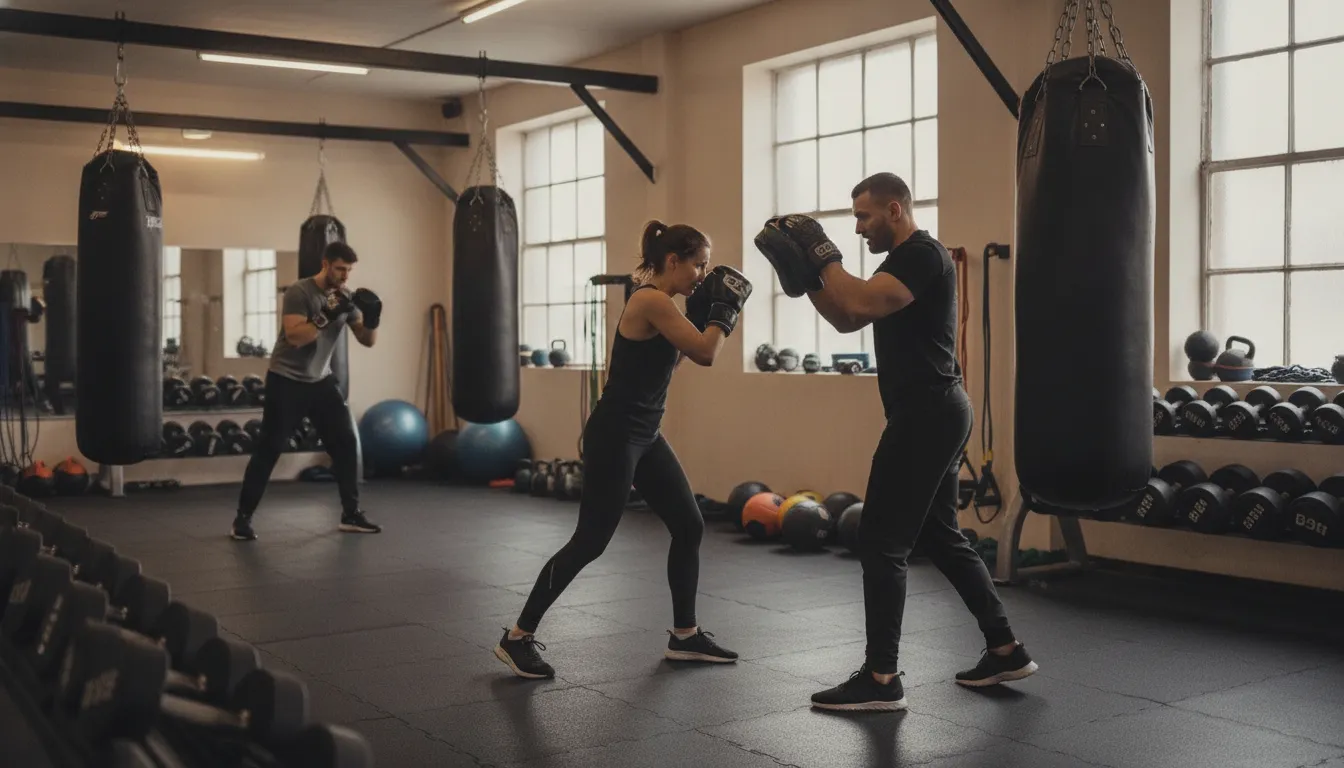
A workout earns its place in your routine when it asks more of you than one isolated movement. Boxing does that through footwork, stance, punches, defensive movement, and repeated changes in pace. Your heart and lungs work while your shoulders, core, and legs help you stay balanced, move well, and produce force.
Explore Grind House boxing classes and find a training format that fits your goals.
Yes, is boxing a good workout depends on how the session is structured, but a boxing fitness class can build conditioning, coordination, and full-body strength through drills that alternate speed and power. You do not need to spar or train to fight for boxing to be an effective workout.
The details matter, especially if you are new to the format. The right class should make the intensity adjustable, teach the fundamentals clearly, and give you a practical way to build consistency. Here is how boxing supports overall fitness, and where it fits alongside the rest of your training.
Is boxing a good workout for overall fitness?
Yes. Boxing can be a strong overall workout when it combines movement, technique, conditioning, and progressive effort. It is not just repeated arm punches. A useful session asks you to manage your stance, move your feet, coordinate your hands, maintain posture, and produce force while your heart and lungs keep working.
That combination is why fitness boxing can support several parts of physical fitness at once. Harvard Health describes fitness boxing as an aerobic activity that can help support muscle strength, endurance, balance, and hand-eye coordination. It also requires constant changes in position and posture, so the work involves attention and control as well as effort. Harvard Health explains the fitness benefits of boxing.
The quality of the workout depends on how the class or session is built. At Grind House, boxing is positioned as a total-body strengthening and conditioning workout that alternates speed and power exercises. That change of pace gives the session more range than staying at one effort level from start to finish. A series of boxing drills and moves can challenge your timing, coordination, footwork, and ability to repeat clean technique as fatigue builds.
The movement also spreads the demand across more than the upper body. Cleveland Clinic notes that throwing a punch recruits the arms, shoulders, core, and legs. While boxing workouts can function as high-intensity interval training that challenges the body and mind. In practical terms, your legs help you stay balanced and move, your core helps connect the movement, and your shoulders and arms help deliver the punch. The result is a workout with cardiovascular and muscular demands, not an isolated arm routine.
Intensity still depends on your pace, technique, rest, and experience. A newer participant may spend more time learning the movement and controlling effort, while a practiced participant may push speed or power further. Boxing can be effective without sparring or competitive fighting. If your broader plan also needs dedicated strength or recovery work, pair boxing with other training instead of expecting one class to cover every goal.
What does boxing train in your body?
A boxing workout is not just an arm exercise. A clean punch starts from the floor, moves through the legs and hips, braces the core, and finishes through the shoulder and arm. That chain is why Cleveland Clinic describes throwing a punch as recruiting the arms, shoulders, core, and legs. The work is distributed across the body rather than isolated in one muscle group. Cleveland Clinic explains the full-body demands of boxing.
Arms and shoulders handle repeated punches, guard positions, and controlled returns. The core helps you stay connected to your stance while your upper body rotates. Legs keep you moving, absorbing each change of direction and helping you create force. At Grind House, boxing class combines drills and movement patterns with speed and power exercises, and the class is designed to challenge the heart, lungs, shoulders, and legs. The result is a session that asks you to work, reset, and work again instead of standing still and throwing from the elbows.
The cardiovascular demand comes from that constant movement. Harvard Health identifies fitness boxing as an aerobic activity and notes that it can support muscle strength, endurance, balance, and hand-eye coordination. It also describes boxing as an activity that requires you to think, change position, and change posture. Those details matter. You are reading a cue, tracking a target, adjusting your feet, and keeping your hands in position while your breathing and effort change. Harvard Health outlines these fitness and movement demands.
Balance and posture are part of the skill, too. A staggered stance places the nondominant hand forward and the dominant hand behind, creating a stable base for movement and force. In a fitness class, that stance supports technique practice and controlled combinations. It does not require you to spar. Fitness boxing may use bags, pads, shadowboxing, and conditioning drills without exposing you to incoming punches. Sparring adds an opponent, defensive reactions, and contact. They overlap in movement skills, but they are different training experiences.
So, is boxing a good workout? It can be, especially when the session combines technique, footwork, conditioning, and progressive effort. It trains your body and your attention at the same time, while the coach can adjust pace, combinations, and rest to match your experience.
How intense is a boxing workout?
Boxing can feel as demanding as you make it. A session may include quick combinations, controlled technique work, footwork, defensive movement, and recovery periods. The intensity comes from how those pieces are arranged, not from throwing every punch at maximum speed.
Some boxing workouts function like high-intensity interval training, challenging both the body and the mind. Cleveland Clinic describes boxing as a form of high-intensity interval training and notes that classes often mimic the movements used during a boxing round. That format asks you to keep track of combinations, stay balanced, and respond to coaching while your heart and lungs are working hard. Cleveland Clinic explains the conditioning demands of boxing.
At Grind House, the class alternates speed and power exercises instead of holding you to one unchanging pace. Fast combinations can raise the demand on your heart and lungs. More powerful punches, stance work, and repeated movement ask more from your shoulders, core, and legs. The drills also require attention to technique, so intensity is physical and technical at the same time.
Experience changes the way a workout feels. A beginner may need more attention for stance, breathing, coordination, and clean punch mechanics. Someone with more practice may increase pace, sharpen combinations, or put more force behind each movement. Neither approach is a shortcut. Sloppy speed is not better training than controlled technique, and adding power before you can stay balanced can make the workout less productive.
That is why there is no single intensity level that defines a boxing workout. Pace sets how quickly you must recover and prepare for the next movement. Technique determines how efficiently you move. The work-to-rest pattern shapes the overall demand, while experience affects how much attention each drill requires. A coach can adjust those variables without turning a fitness class into fight preparation.
Rest matters, too. A well-paced session gives you room to reset, listen for the next instruction, and return with better form. As your conditioning improves, you may be able to work with more consistency between recovery periods. If you want a deeper look at how rounds, intervals, and recovery can be organized, read this guide to boxing HIIT training. This article’s broader point is simpler: boxing intensity should match the workout design and the person doing it.
Can beginners get a good workout from boxing?
Yes. Beginners can get a productive workout from boxing without knowing how to fight, moving at an advanced pace, or stepping into a sparring match. A fitness boxing class can focus on stance, footwork, technique, drills, and conditioning. You still have to work, but the challenge can be scaled through pace, power, rest, and how much technical detail you take on at once.
Start with the stance. In a staggered stance, the nondominant hand sits forward while the dominant hand stays behind the body to help generate force. That position gives a coach a practical foundation for teaching balance, movement, and basic punches. It also gives a new member something concrete to practice instead of simply throwing punches as fast as possible.
That distinction matters. Boxing fitness does not have to involve sparring. A class can use boxing drills, movement, and conditioning to challenge your heart, lungs, shoulders, and legs while you learn the mechanics. At Grind House, the boxing format is described as a total-body strengthening and conditioning workout that alternates speed and power exercises. The goal is useful training, not pretending every beginner is preparing for a fight.
If you want a clearer picture of what happens in boxing class, look for a session that explains the movements before asking you to increase intensity. You can also review the first boxing workout guide, while keeping your focus on learning rather than chasing a perfect first session.
What should a beginner bring?
Grind House members must bring their own hand wraps and gloves for boxing classes. That is a small practical detail, but having the right equipment makes it easier to participate comfortably and focus on technique. If you are unsure how to begin or how boxing fits your goals, Grind House includes a complimentary training assessment with membership. Use that conversation to clarify your experience, training priorities, and an appropriate starting point.
Boxing can be a good workout for a beginner because progress starts with repeatable fundamentals. Learn the stance, stay controlled, and build consistency before trying to make every round harder.
What are the limits of boxing as a workout?
Boxing can deliver serious conditioning, but it is not a complete answer to every training goal. A fitness boxing class may involve repeated drills, footwork, speed, power, and whole-body effort. That makes it a useful workout. It does not automatically replace a structured strength program, guarantee weight loss, or teach the skills required for competitive fighting.
Boxing is not the same as progressive strength training
Throwing punches challenges the shoulders, arms, core, and legs, especially when you are moving with purpose. Still, strength development usually benefits from planned resistance, consistent loading, and recovery between sessions. A boxing class can complement that work, but it may not provide enough focused resistance for every muscle or every strength goal. If building measurable strength is a priority, add dedicated strength sessions rather than assuming every hard round covers it.
Hard work does not guarantee a specific body change
Boxing can raise the intensity of a workout, and Grind House describes its class as total-body strengthening and conditioning that alternates speed and power exercises. The effect you get still depends on your pace, technique, rest, experience, and consistency. No class can promise a particular amount of weight loss. Progress also depends on the broader pattern of training, food, sleep, and recovery. That is a reason to set realistic goals, not a reason to dismiss boxing.
Fitness boxing does not automatically make you a fighter
Bag work, pad drills, and movement can build coordination and conditioning without being sparring or fight preparation. Competitive fighting requires additional technical coaching, controlled practice, defensive work, and an appropriate training environment. Many people do not need those skills. They want a challenging, engaging way to train, and fitness boxing can meet that need without stepping into the ring.
The best approach is to use boxing as one part of a well-rounded routine. Grind House offers boxing alongside HIIT, Turf & Tread, kettlebell, yoga, and Pilates/Barre, giving members options for strength, conditioning, movement, and recovery. Explore the boxing and group fitness classes to build a mix that matches your goals.
How should you decide if boxing fits your routine?
The right workout is the one you can perform consistently and balance with the rest of your training. Boxing can be a strong choice if you enjoy skill practice, moving with purpose, and alternating bursts of speed and power. It may be less suitable as your only training mode if your main goal is progressive lifting. Or if your body needs a lower-impact session on a given day.
Use the comparison below to match the session to what you need today. These options are not competing identities. A well-rounded beginner workout routine can include more than one of them across the week.
| Training option | Primary emphasis | What you practice | When it fits |
|---|---|---|---|
| Boxing session | Conditioning, coordination, and whole-body movement | Stance, footwork, drills, punches, changes in speed, and controlled power | When you want an engaging workout that challenges your heart, lungs, shoulders, and legs while building a skill |
| Traditional strength session | Strength development and resistance progression | Loaded movements, technique under resistance, and repeatable exercise patterns | When improving strength is the main priority and you want to track resistance or movement progress directly |
| Lower-impact or recovery option | Movement quality, mobility, and manageable cardiovascular work | Controlled movement, breathing, range of motion, and recovery-focused effort | When you need to reduce impact, manage fatigue, or keep your routine moving between harder sessions |
At Grind House, boxing is described as total-body strengthening and conditioning built around drills that alternate speed and power. That makes it a useful fit for readers who want more than a repetitive cardio session, but it does not automatically replace dedicated strength or recovery work. The gym also offers options such as kettlebell, yoga, Pilates, Barre, HIIT, and Turf & Tread, so you can build a mix around your goals.
If the training style sounds like your kind of work, explore the available boxing classes and choose a schedule you can realistically repeat.
Take the next step toward a boxing workout that fits your routine.
Frequently Asked Questions
Is boxing a full body workout?
Yes. Effective boxing uses more than your arms. Punches recruit the shoulders, arms, core, and legs, while footwork and changes in posture keep the lower body involved. Harvard Health also identifies fitness boxing as an aerobic activity that can support strength, endurance, balance, and hand-eye coordination. Harvard Health explains the broader fitness benefits of boxing.
Is boxing a good way to lose weight?
Boxing can support a weight-management plan because it combines movement, conditioning, and variable effort. The result depends on your overall activity, nutrition, recovery, and consistency, so no workout can guarantee weight loss. Treat boxing as one useful training tool rather than a promise of a specific body change.
Is 30 minutes of boxing a day enough?
Thirty minutes can be a productive session when it includes purposeful drills, steady movement, and an effort level you can perform with sound technique. Whether it is enough depends on your goal and how the session fits with the rest of your week. Start at a manageable pace, build consistency, and allow recovery instead of forcing maximum intensity every day.
What are the downsides of boxing as a workout?
Boxing may not cover every training need on its own. Fitness boxing can challenge conditioning and coordination, but it is not automatically a complete strength program or a substitute for recovery work. Pair it with appropriate strength, mobility, or lower-intensity training when those qualities matter to your goals. If you are new, learn the stance and punch mechanics before chasing speed or power.
Ready to Explore Boxing Classes?
Boxing can give your routine a practical mix of conditioning, coordination, strength demands, and adjustable intensity. The right class can help you turn those elements into a consistent training session, whether you are building a foundation or looking for a new challenge. Explore Grind House boxing classes and choose the next step that fits your training goals.
Leave a Reply
You must be logged in to post a comment.